
Return to the previous menu.
Most GOES products will either benefit or remain unchanged by the addition of a 13.3 micron channel. Adding this channel at the cost of the 12 micron channel, however, will have negative implications for other products.
Those products impacted negatively include products that rely on cloud detection and low-level moisture such as sea surface temperature, skin temperature, lifted index, and those products relying on the detection of volcanic ash and dust.
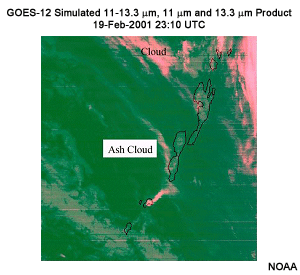
Image products used to detect and track dust and ash plumes typically utilize the contrasting spectral characteristics of dust and ash in the 10.7 and 12 micron channels. The volcanic ash product seen on the left is using 10.7 and 12 micron channel combinations from MODIS to simulate GOES-8 while the product image on the right is using 10.7 and 13.3 micron channel combinations from MODIS to simulate GOES-12. Notice how much more of the ash plume's extent is visible in the 10.7/12 micron product and how relatively well the ash plume is distinguishable from nearby cirrus clouds.
Some of the degradation in the detection of volcanic ash plumes may be offset during daytime by including information from the visible and 3.7 micron channels. Other strategies include the complementing of GOES products with imagery and products from polar-orbiting satellites.