
Feature Identification Exercises
Print Version
Introduction and Overview
Identifying clouds over snow on the ground is an important and difficult problem for the meteorologist concerned with short-term forecasts impacting both aviation and ground operations. For example, low stratus and fog affect surface visibilities and may indicate the presence of icing.
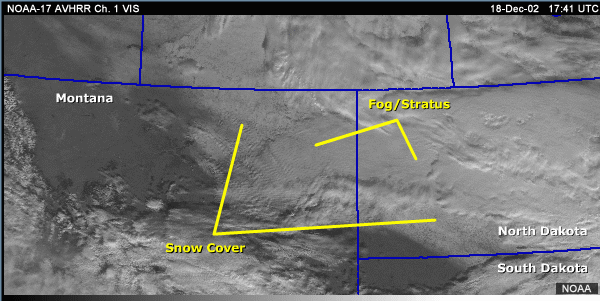
Orographic clouds may provide clues to the presence of mountain wave
turbulence.
There are a variety of different cloud features that help the forecaster
determine a range of atmospheric conditions that may impact an analysis
or forecast.
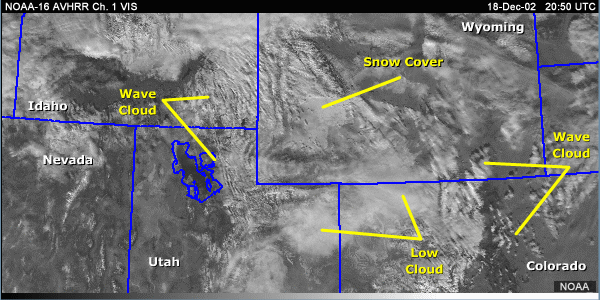
Discriminating between low clouds, snow, and ice cover poses
many challenges when analyzing imagery at conventional visible and longwave
infrared window wavelengths. Snow, ice, and clouds all reflect incoming
solar energy and thus take on a similar appearance at visible wavelengths.
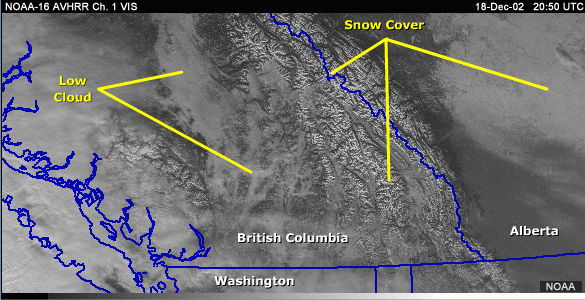
At longwave infrared wavelengths where snow, ice, bare ground, and low clouds often radiate at similar temperatures, especially at night, distinguishing one feature from another becomes a difficult task.
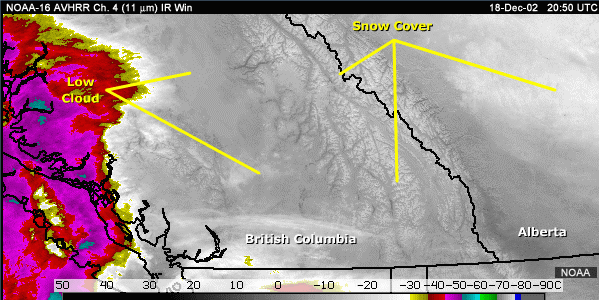
This set of mini-examples demonstrates a multi-channel strategy to address the snow, ice, and low cloud identification problem. Visible and longwave infrared imagery will be examined in combination with imagery from two shortwave infrared channels.
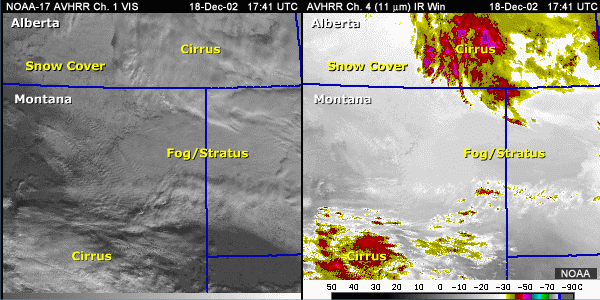
A shortwave infrared imaging capability is available with the GOES, NOAA, and NASA-EOS (Terra and Aqua) satellites. A similar capability is planned for NPOESS and METOP. Centered at either 1.6 or between 3.5 and 4 micrometers, these channels detect varying amounts of reflected solar radiation depending on whether water is in liquid or ice form, and whether it is present in a cloud or on the surface.
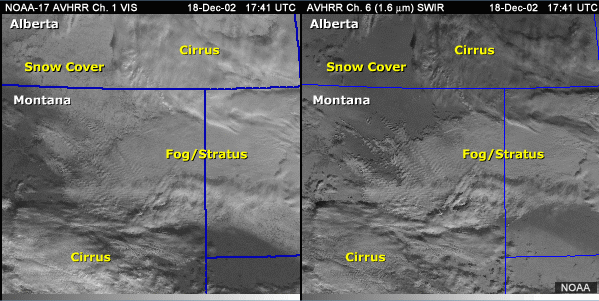
More 1.6-micrometer imagery is becoming available as new satellites are launched. As of early 2003, satellites with a 1.6-micrometer channel include NOAA-16, -17, Terra, and Aqua.
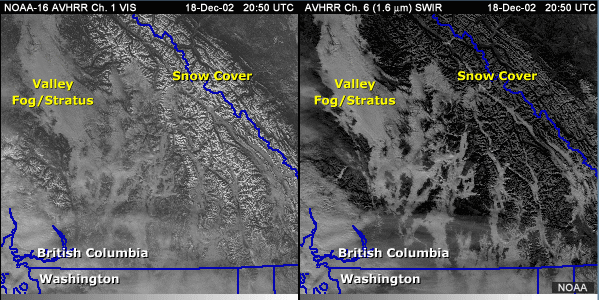
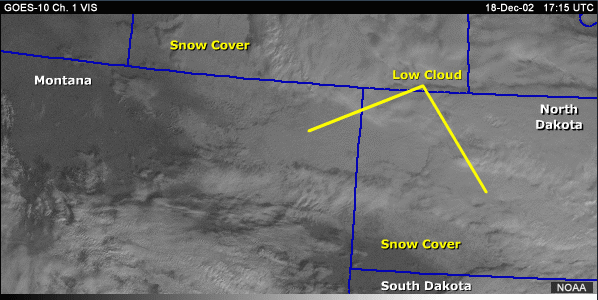
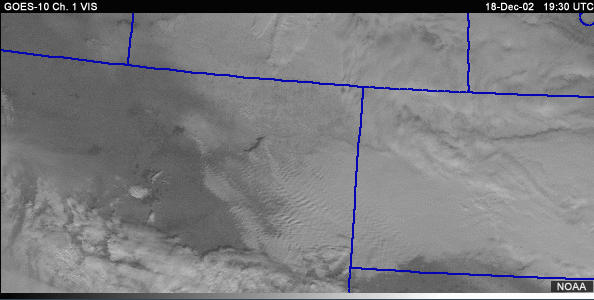
Animation of visible and longwave infrared imagery from either geostationary or polar orbiting satellites can help the analyst distinguish between clouds and ground in many situations. However, low stratus and fog, especially radiation fog and valley fog, often remain undetected. The cloud feature’s slow movement or its appearance over areas of snow and/or ice cover reduces the contrast between the cloud feature and the surface.
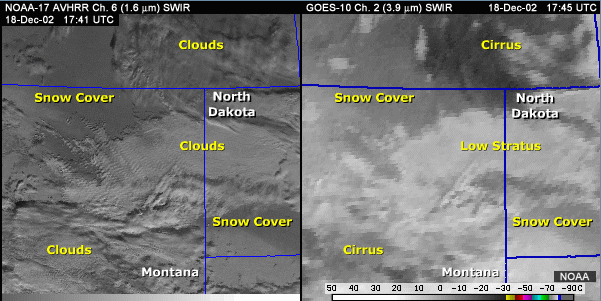
In the absence of animation, a broader multispectral analysis offers a significantly enhanced approach to detecting clouds, snow, and ice cover. The key to this approach is shortwave infrared imagery between 3.5 and 4 micrometers and a relatively new 1.6-micrometer channel capability available with NOAA-AVHRR and Terra and Aqua MODIS. In combination with visible and infrared imagery, shortwave infrared imagery can help distinguish clouds from surface types and determine cloud phase, as well as differences between snow and ice cover. Water clouds between 3.5 and 4 micrometers are more reflective and appear brighter (warmer) than ice clouds, snow, and ice cover. A 1.6-micrometer channel has the added value of being able to distinguish between ground features and most cloud types.
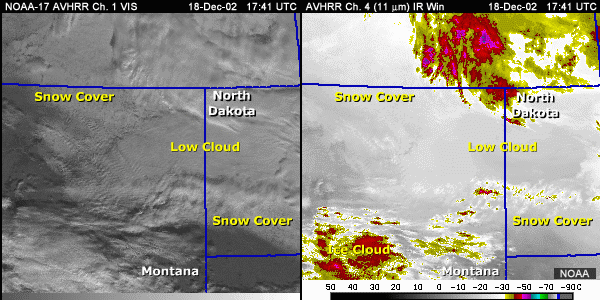
Low clouds, snow, and ice often appear indistinguishable in visible and longwave infrared imagery, especially in the absence of animation.
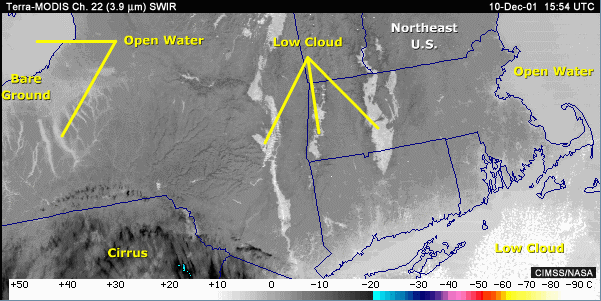
While channels between 3.5 and 4 micrometers are effective for discriminating low water clouds from ice clouds, and snow and ice cover during daytime, their added sensitivity to thermal emissions may result in low clouds and fog appearing indistinguishable from nearby open water or warm ground.
Visible Channel
Advantages
The best uses for the visible channel for feature detection include:
· Clouds, snow, and ice appear relatively bright (reflective)
compared to bare ground and open water
· This channel is best used in combination with shortwave infrared
channel (1.6 or 3.5 to 4 micrometers) for distinguishing clouds
from snow and ice cover
The limitations for feature detection using the visible channel include:
· Distinguishing between clouds, snow, ice, and other
reflective surfaces, particularly in the absence of animation
· Detecting open water when surrounded by dense forest
because both are poorly reflective in the visible
Channel 6 SWIR (1.6-micrometer)
Advantages
The best uses of the 1.6-micrometer shortwave IR channel for feature detection include:
· This channel excels at distinguishing clouds and cloud boundaries,
especially from snow and ice covered surfaces. Water clouds
between 3.5 and 4 micrometers are more reflective and appear
brighter (warmer) than ice clouds, snow, and ice cover.
· This channel was recently added as the daytime shortwave
infrared channel on NOAA-16 and -17 (replaced with a
3.7-micrometer channel during nighttime) and is a dedicated
channel available via direct broadcast with the MODIS instrument
on board NASA-EOS's Terra and Aqua polar orbiters
· In combination with the visible channel, it can distinguish
clouds from snow and ice cover
Limitations
The limitations of using the using 1.6-micrometer shortwave IR channel for feature detection include:
· It can be difficult to distinguish between clouds and bare ground
since bare ground tends to be more reflective at 1.6 micrometers
· It is more difficult to discriminate between snow and ice cover
compared to viewing with channels between 3.5 and 4 micrometers
Channels between 3.5 and 4 micrometers
***NOTE: In this module, we represent channel range using
MODIS channel 22, centered at 3.9 micrometers. ***
Advantages
The best uses of channels in the 3.5- to 4-micrometer range for feature detection include:
· Distinguishing water clouds (highly reflective and warm)
from ice cloud, snow and ice cover (poorly reflective and
cold),
and colder bare ground
· Detecting open water when surrounding ground is significantly
colder or warmer, and not covered by snow and/or ice. Open
water
and vegetated surfaces, particularly forests composed of needle
trees, are poorly reflective and difficult to distinguish
in the visible.
· Detecting water clouds at night when used in combination with
the longwave infrared channel
· Detecting ice clouds in combination with visible and 1.6-micrometer
imagery when available, or visible and longwave infrared channels
· Distinguishing low clouds from snow and ice cover in combination
with the visible channel
· Discriminating high clouds from snow and ice cover in combination
with longwave infrared channel
Limitations
The limitations of using the using the 3.5- to 4-micrometer range shortwave IR channel for feature detection include:
· Difficulty distinguishing ice clouds from snow and ice cover
as both
are poorly reflective and appear relatively dark or cold
in the imagery
· Difficulty distinguishing water clouds from open water or warm
land.
A water cloud reflects incoming solar energy such that its
brightness temperature can approach the temperature of
adjacent water or bare ground
Channel 31 (11-micrometer) IR Window
Advantages
The best uses of the 11-micrometer IR window imagery for feature detection include:
· Detecting relatively cold cloud-top features associated with
convection, cirriform, and mid-level cloud types
· Can be used in conjunction with cloud phase information
obtained
from shortwave infrared channels to help determine potential
for icing
· Can be used in combination with shortwave infrared imagery for
discriminating ice clouds at night. During daytime, it can
be used to discriminate high clouds from snow and ice cover or in
combination with shortwave IR and visible imagery.
· Can be used in conjunction with a shortwave infrared channel
(between 3.5 and 4 micrometers) to detect water clouds at
night
Limitations
The limitations of the 11-micrometer IR window channel for feature detection include:
· Distinguishing low clouds from relatively cold ground or water,
a condition common during wintertime and at night
· Distinguishing between snow, ice cover, and adjacent frozen
ground is very difficult
· Alone it cannot confirm the presence of supercooled water clouds,
generally present between 0 and -15 degrees C