Feature Identification Exercises
Print Version
Summary
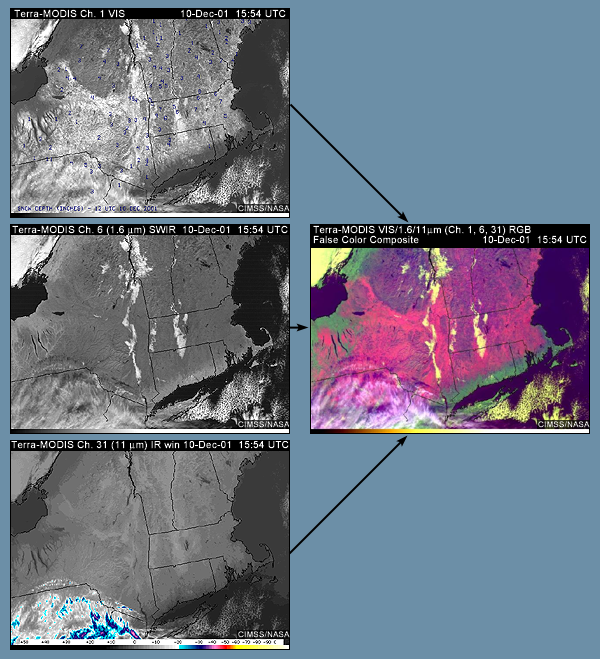
The MODIS Feature Identification Exercises training module has demonstrated an effective daytime use for multispectral MODIS imagery in the identification of clouds over snow and ice cover through four mini-exercises. NOAA-16, -17 and EOS polar satellites, Terra and Aqua are demonstrating a set of multispectral imaging capabilities for land, ocean, and atmosphere applications that foreshadow major advances in remote sensing during the coming decade. Familiarization and practice with data from this group of satellites will help forecasters prepare for the new suite of multi-spectral sensing tools becoming available with NPOESS and METOP satellites over the course of the next several years.
The following is a summary of clouds over snow and ice detection strategies as covered in this module:
· 1.6-micrometer channel imagery is best for distinguishing most
cloud types, except for
very thin cirrus (3.9 and 11-micrometer channels improve the
detection of thin cirrus)
· In the 1.6-micrometer channel, clouds appear brighter and are
easily separated from
the darker less reflective underlying snow and ice cover
· In the absence of a 1.6-micrometer channel, the 3.9-micrometer
channel is an effective
detection tool for identifying low water clouds
· Visible and 1.6-micrometer imagery is an effective combination
in the detection of
clouds for complex scenes containing a mixture of clouds,
snow, bare ground, and forest
· Cloud type can be assessed with a combination of shortwave and
longwave infrared
imagery
-3.9-micrometer imagery is useful for determining cloud phase
(water droplets appear warm/reflective)
- cloud height can be inferred from 11-micrometer cloud-top
brightness temperatures
(in combination with the 1.6 or 3.9-micrometer imagery,
can help detect the presence
of super-cooled water clouds)
· The visible and 1.6-micrometer channels are an effective combination
in separating
ice from open water
- Open water is poorly reflective/dark compared with and
other surfaces types in
these two channels
· For cold scenes, 3.9- and 11-micrometer imagery can help with
then detect of
relatively warm surface water associated with open rivers and lakes
· Both 1.6- and 3.9-micrometer imagery can help to confirm the
presence of
snow cover within forested regions
· Imagery that combines the visible, 1.6- (or 3.9-) and 11-micrometer
channels to create
false-color composites, is a technique that can be employed to
highlight the strengths
of each channel in a single image product
· Multi-channel compositing can help the analyst reduce the time
currently needed for
examining individual channel image products while increasing the
likelihood of detection
for specific features
· Channel compositing techniques that focus on specific meteorological
features will become
increasingly important as the number of available spectral channels
continues to increase
· The range of detectable features and the accuracy with which
they are characterized will
continue to improve as the number and resolution of available spectral
channels increase