4.3.1 Satellite Detection of Blowing Snow
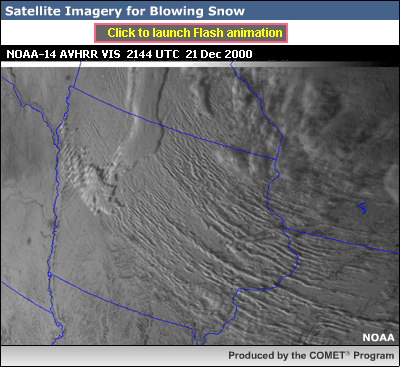
Detection of blowing snow by satellite and in situ observations becomes important for issuing watches and warnings. Blowing snow episodes often start with high winds and relatively clear skies. Under those initial conditions, landmarks such as rivers and lakes are often well defined as dark areas, surrounded by white snow. Where clouds are present, it is often difficult to distinguish between cloud and snow. With visible images, animation will show cloud motion. However with blowing snow, how does one know that the observed features are bands of clouds or blowing snow? In those cases, multi-spectral images are needed to provide that distinction.
A blowing snow episode over Iowa is captured by visible, shortwave IR, and longwave IR imagery. The visible image shows shadows cast by lines of snow or low-level clouds. In the longwave IR image, the bands are somewhat obscured, however, the image shows colder features to the north and west. The shortwave IR (3.7 micrometer) is more useful for identifying clouds, which are a mixture of water droplets and ice crystals warmer than -10ºC (yellow enhancement - reflecting sunlight) and blowing snow, which is composed of ice crystals and has poorer reflectivity (blue enhancement).
Click to open new window with Flash animation (230KB)