Return to the previous menu.
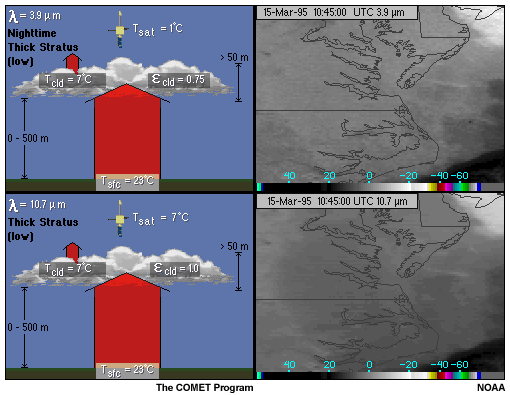
The 3.9 and 10.7 micron channels may be used to produce a nighttime image product that delineates ice and water clouds.
The product is generated by differencing the derived scene temperatures at 10.7 and 3.9 microns.
The models in the left panel show the interaction between earth-emitted radiation and water clouds at 10.7 microns and 3.9 microns, as well as the resultant emission from those clouds.
Since thick clouds completely absorb earth-emitted radiation at both wavelengths, the satellite primarily senses energy emitted from cloud top.
Since the emissivity of water clouds at 3.9 microns is less than at 10.7 microns, the cloud image appears cooler in the 3.9 micron channel.
Next | Previous | Main Menu | Page: 1 | 2 | 3 | 4 | 5 | 6 | 7