Return to the previous menu.
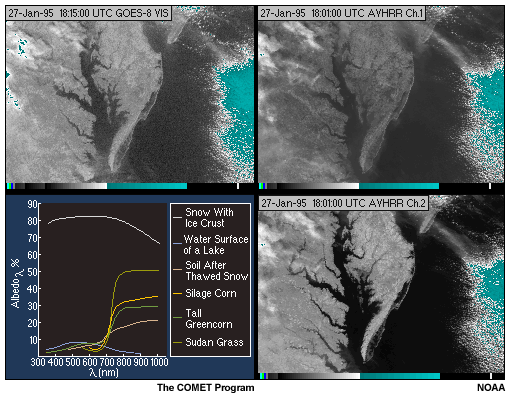
The graph on the lower left shows albedos for water and different types of vegetation. Reflection from vegetation increases with wavelength, with a marked change around 0.7 microns.
Notice that water is poorly reflective, with almost no reflection beyond 0.9 microns. The AVHRR channel 2 image appears brighter with more contrast because various surfaces have vastly different albedos.
Comparison of the GOES image with the AVHRR images shows the result of the GOES visible channel extending out to 0.75 microns. Notice that as wavelength increases beyond 0.7 microns, land appears brighter while water becomes darker.
Turbid water is detectable in AVHRR channel 1 and GOES visible imagery.
Increases in turbidity usually follow meteorological episodes such as strong flow across coastal zones or heavy rains and resultant runoff into rivers and lakes.
Next | Previous | Main Menu | Page: 1 | 2 | 3 | 4 | 5 | 6 | 7 | 8 | 9 | 10 | 11 | 12 | 13 | 14 | 15 | 16 | 17 | 18