Return to the previous menu.
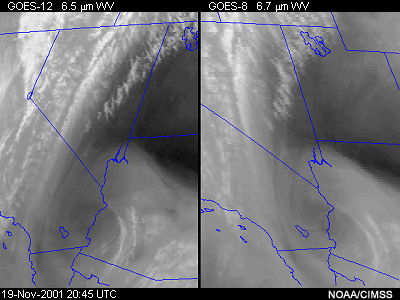
The effect of a broader spectral response in the GOES-12 6.5 micron water vapor channel can be seen in this comparison between GOES-12 (left) and GOES-8 (right).
Notice that the GOES-12 scene appears warmer, particularly within the relatively cloud-free regions. The GOES-12 6.5 micron channel is sensing infrared radiation from a somewhat deeper, lower, and generally warmer mid-tropospheric layer. Also, the cirrus clouds in this scene actually appear somewhat colder in the GOES-12 image. This is due primarily to the increased 4 km resolution of the GOES-12 water vapor channel (8 km on GOES-8 to -11) whereby GOES-12 can resolve finer cloud structures.
Both estimates and observations show that the average satellite brightness temperatures are 2-3 K warmer with GOES-12 than with GOES-8 or -10. Most quantitative applications should be unaffected if the correct spectral response function is used to account for this change.
Next | Previous | Main Menu | Page: 1 | 2 | 3 | 4 | 5 | 6 | 7 | 8 | 9 | 10 | 11 | 12 | 13 | 14 | 15 | 16 | 17