Return to the previous menu.
|
|
|
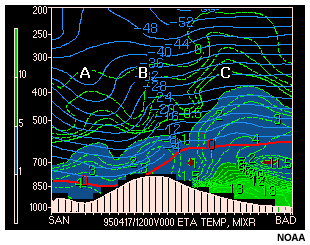
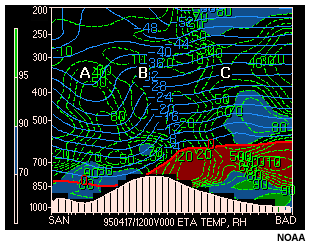
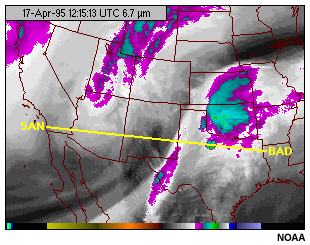
Notice that in region A of the cross section, colder air and higher moisture values above the 500-millibar level found within the base of a vigorous shortwave combine to produce lower radiance values and a brighter appearance in the image. At location B of the cross section, notice the presence of somewhat dryer and warmer air associated with subsidence and advection processes along a strong north-to-south baroclinic zone. Here the 6.7 micron channel detects energy from a somewhat lower and warmer layer in the atmosphere than to the west, resulting in a darkening of the image. Relative humidities in excess of 80%, between 200 and 250 millibars across region C, indicate that the 6.7 micron channel may be detecting radiances originating from that layer. Examine more closely the cross section of temperature and mixing ratio. Satellite brightness temperatures across region C closely resemble the 200- to 300-millibar layer mean temperatures. Sufficient moisture is present for the 6.7 micron channel to sense energy from that layer.
Next | Previous | Main Menu | Page: 1 | 2 | 3 | 4 | 5 | 6 | 7 | 8 | 9 | 10 | 11 | 12 | 13 | 14 | 15 | 16 | 17